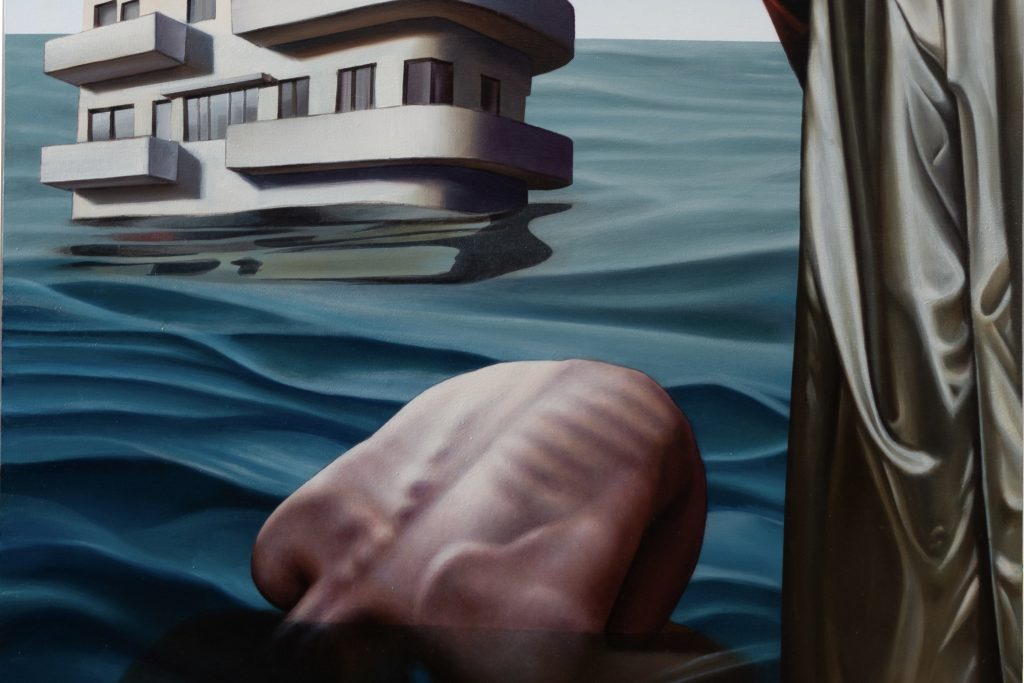
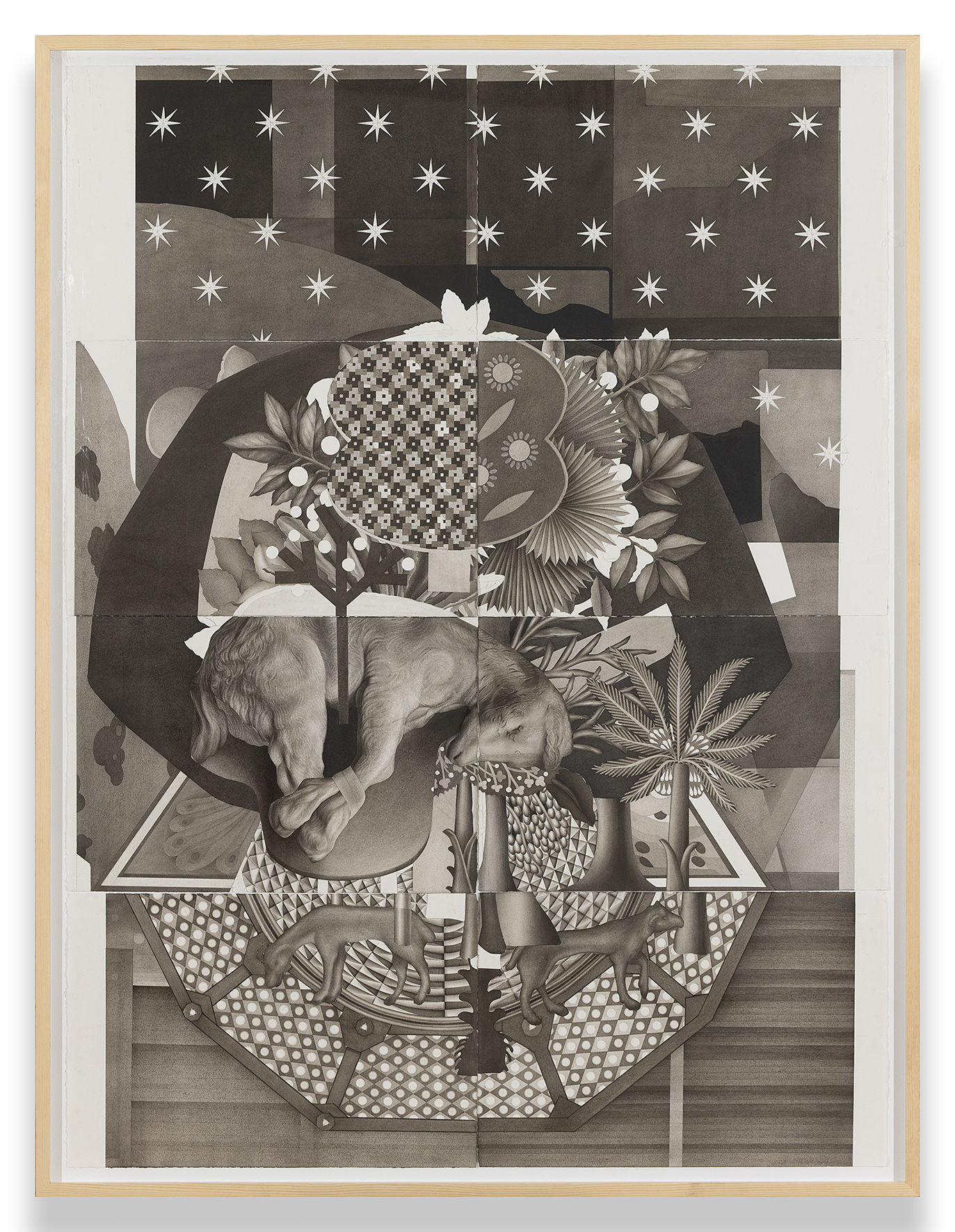
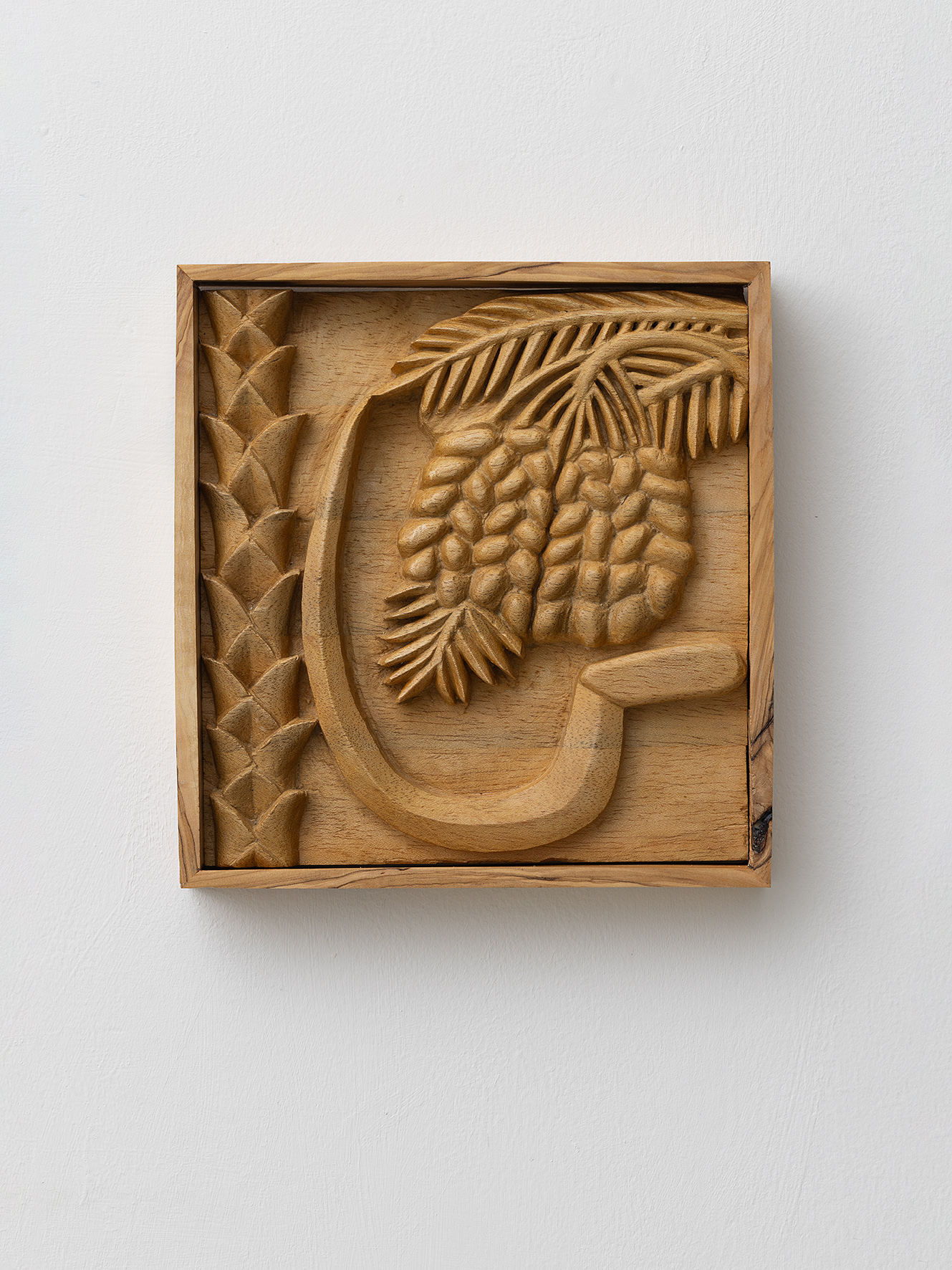
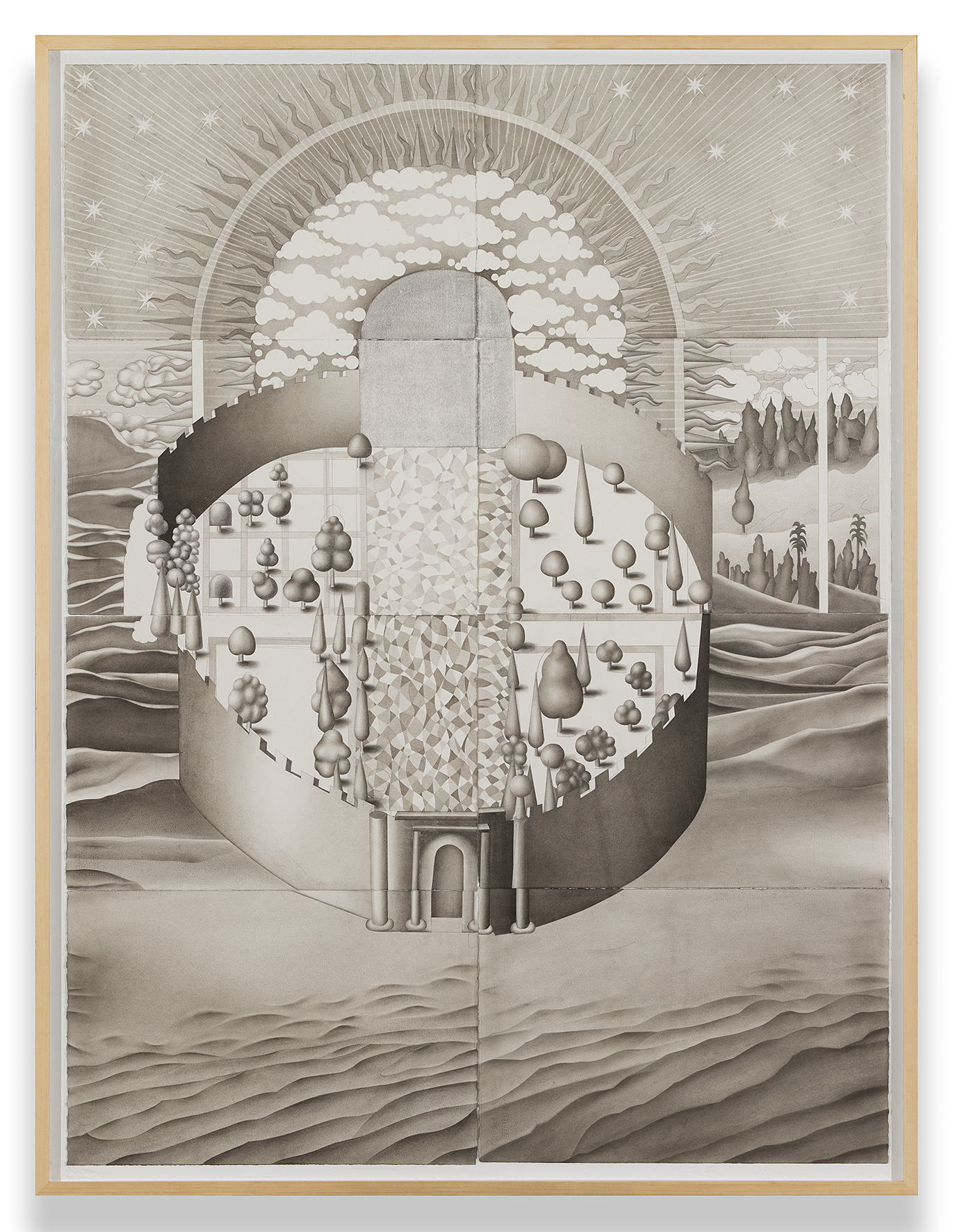
There is a moment when an image ceases to explain the world and simply becomes an image. Itay Matan’s exhibition perhaps begins at that moment, with a backward glance toward the possibility that things were once connected differently. There were times when a plant, an animal, a body, a star, a river, or a geometric form were not merely things in the world, but signs within a system larger than themselves. The world was filled with analogies, allegories, gods, signs, and hidden forces. It could be read.
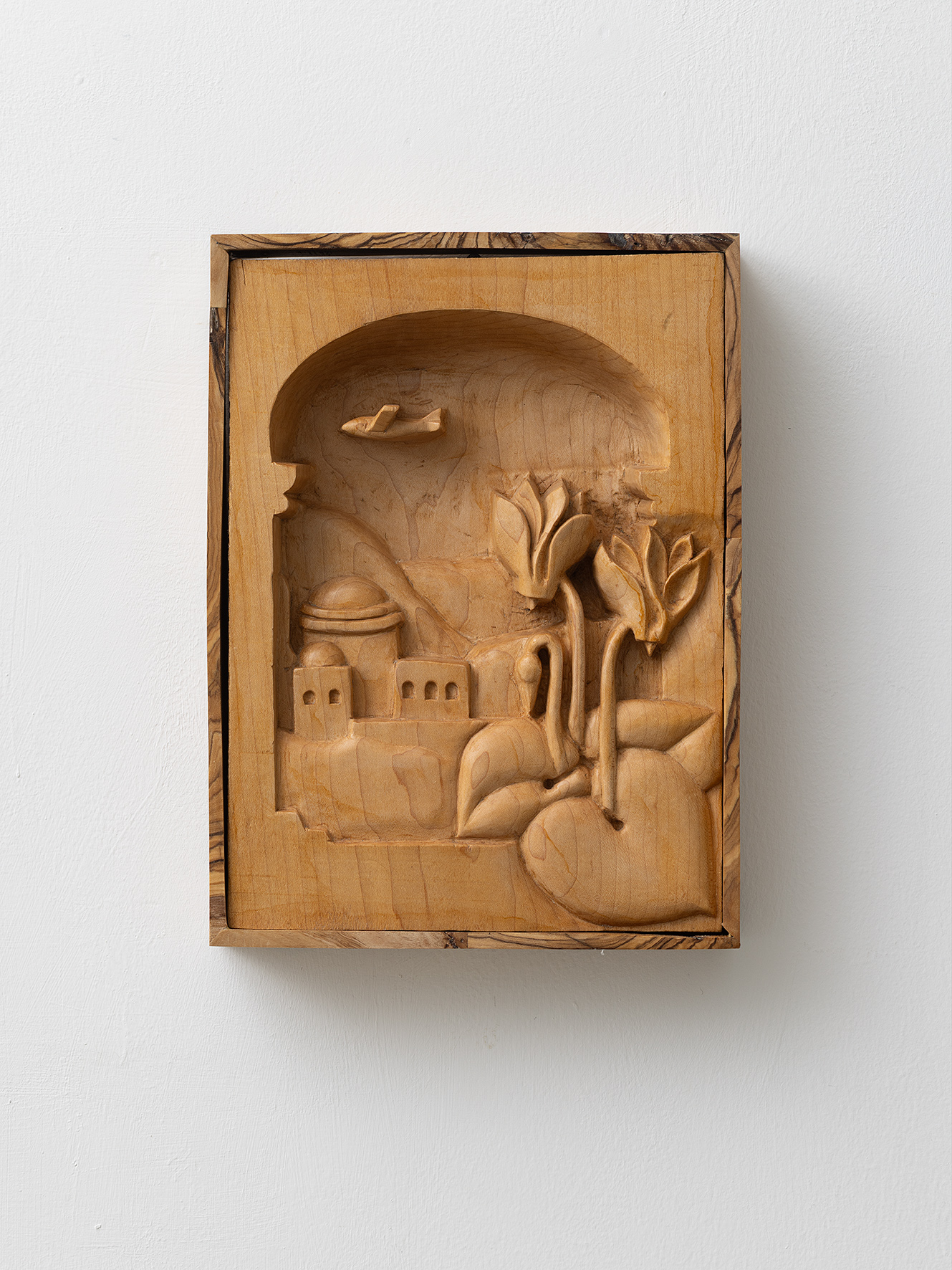
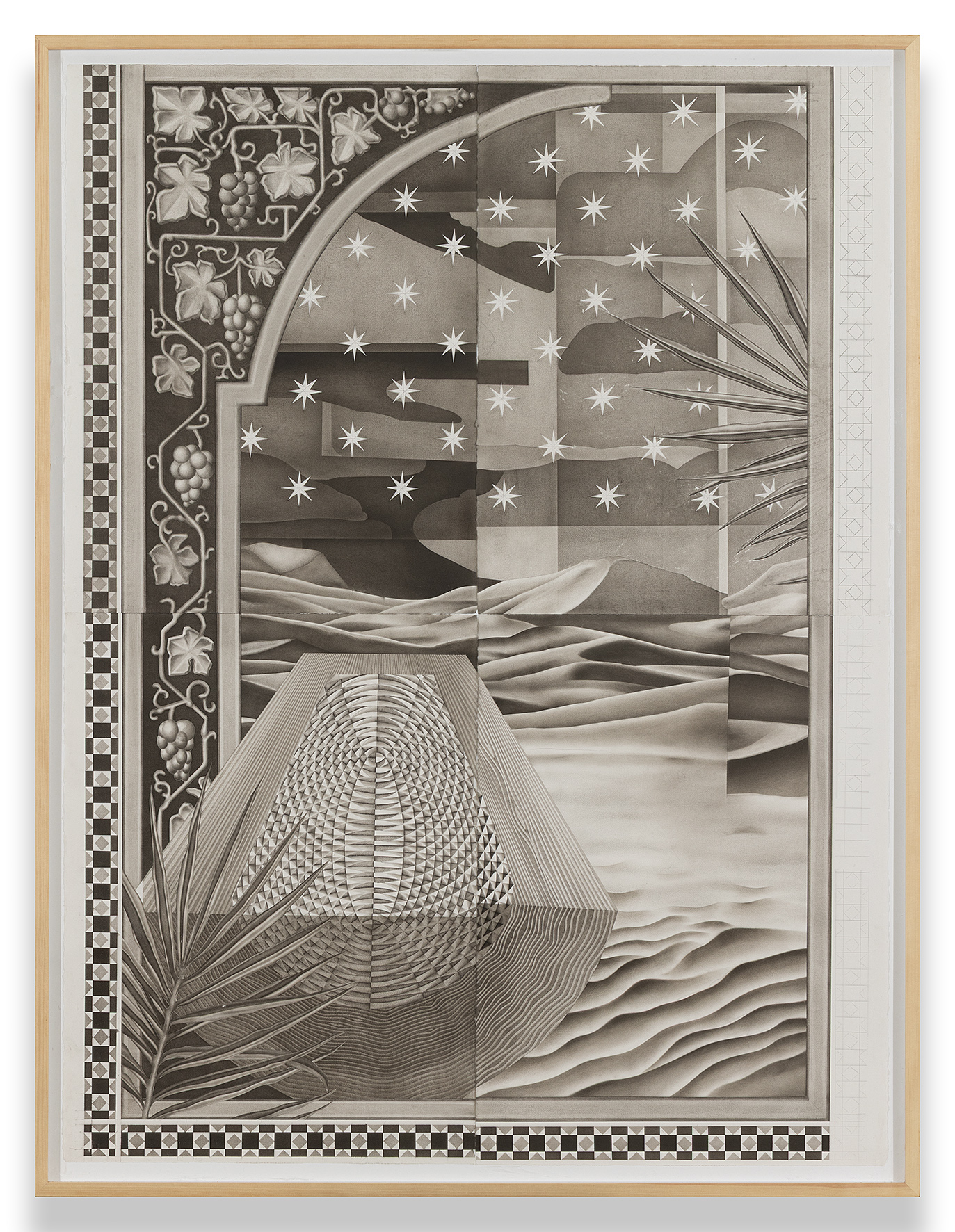
In Matan’s drawings and wood reliefs, remnants of such worlds appear. Bodies and water, vegetation and fruit, animals, structures, machines, geometric forms, and images drawn from different periods and visual languages. At times they recall medieval iconography, at others a ritual relief or folk art, and at still others an entirely contemporary image. They meet within a single work as though they had always belonged to the same system, except that the system itself no longer exists.
In the wood reliefs, this becomes almost tangible. Carving, a craft associated with ancient traditions of ornament, ritual, and the transmission of stories, is used to construct configurations whose laws are difficult to decipher. Clusters of fruit, leaves, bodies, animals, architecture, and cogwheels exist side by side. They look like symbols, yet their meaning is withheld from us. Like fragments of a relief from a culture we do not know, they evoke the sense that there was once a story here, even if we no longer know how to read it.
Perhaps for this reason, the tension in the works does not lie between belief and disbelief, but between different systems through which human beings have repeatedly attempted to make reality intelligible. The mythological, the religious, the scientific, and the technological are not necessarily opposites. Each, in its own way, proposes an order: a set of relations between things, a governing logic, cause and effect, the promise that the world is not merely a random collection of phenomena. The act of drawing is itself such a system.
Matan moves freely between art history and images that have lost the contexts from which they emerged. A river may carry within it the memory of another painting, a relief of a male torso may echo iconic sculptures of the past, a form that appears almost scientific may suddenly become cosmological. History appears here not as an ordered sequence, but as an archive of forms that have survived the systems that once gave them meaning. From here, one might ask: what happens after the great systems through which we explained the world begin to lose their power?
We live in an age that promises almost total visibility. The world is continuously photographed, mapped, measured, catalogued, and processed. Ostensibly, we have never known more about it. And yet an abundance of knowledge does not necessarily produce meaning. At times, the opposite seems to occur. The more things become accessible to explanation, the more they lose something of the depth, mystery, or power they possessed when they could not be seen in their entirety.
This can be understood as a longing for ordering ideas. Throughout history, human beings have attempted to formulate systems through which things could be connected and the world given structure: mythology and religion, cosmology, science, geometry, and technology. In this sense, there is no need to regard the scientific and the spiritual as opposites. Both arise, in part, from the same persistent human desire to discover order within multiplicity, to understand how one thing relates to another, and to believe that beneath apparent contingency some kind of order exists. But perhaps this longing conceals another assumption: that the world itself has been emptied out.
In the thought of James Hillman, an opposite possibility emerges. Hillman returns to the ancient idea of anima mundi, the “soul of the world,” challenging the modern division between a human being endowed with a soul and an external world composed of mute objects. He does not necessarily propose a return to an ancient belief, but rather a shift in the way we look: the possibility that things are not neutral matter waiting for us to bestow meaning upon them, but that they already appear before us possessing qualities, presence, and imaginal power. In this sense, the world has not stopped speaking. Perhaps we have stopped listening.
Perhaps water is not a metaphor for something else. Perhaps the body, the tree, the plant, and the machine are not pieces of a riddle waiting to be solved. Matan’s gesture may instead be to suspend, for a moment, the need to decipher, allowing things to appear once again in the fullness of their strangeness.
In this sense, one might think of Jun’ichirō Tanizaki In Praise of Shadows. Tanizaki wrote of a beauty that does not reside in full illumination, but precisely in half-darkness, reflection, ambiguity, and in things that do not reveal themselves to the gaze all at once. This is not an opposition to knowledge, but a recognition that not everything becomes richer the more fully it is illuminated. In Matan’s exhibition, too, the question seems not to be how to restore a lost belief to the world, but what happens to the imagination when everything demands to be explained.
In this exhibition, Matan turns to another textual source: the Song of Songs. The poem describes the dance of courtship, forever unfulfilled, between the people of Israel and their God. The world it describes is entirely charged: garden, spring, fruit, wine, scent, animals, and the human body are not separated from one another. One thing can become another. Nature describes the body, and the body becomes landscape. It is a world in which things do not merely represent meaning, they resonate with one another. Something of this possibility also hovers over Matan’s works, not as a belief to which one can return, nor as an object of longing.
The drawings and reliefs do not reconstruct an enchanted world, nor do they offer a new system to take its place. On the contrary, they leave the connections exposed, partial, and at times impossible. The signs are still here, but the key that was meant to decipher them has been lost. This is where the magic begins. Formal gestures allow things that cannot be reconciled to exist, for a moment, together: science and myth, body and landscape, machine and plant, past and present, knowledge and belief. Not a complete system, but the possibility of imagining that perhaps there are still connections for which we have no name.